Steve Etcher with the Greater Warren County Economic Development Council to discuss the county’s existing tax abatement agreements with the two solar districts and American Foods Group on Aug. 7.
This item is available in full to subscribers.
We have recently launched a new and improved website. To continue reading, you will need to either log into your subscriber account, or purchase a new subscription.
If you are a digital subscriber with an active subscription, or you are a print subscriber who had access to our previous wesbite, then you already have an account here. Just reset your password if you have not yet logged in to your account on this new site.
If you are a current print subscriber and did not have a user account on our previous website, you can set up a free website account by clicking here.
Otherwise, click here to view your options for subscribing.
Please log in to continue |
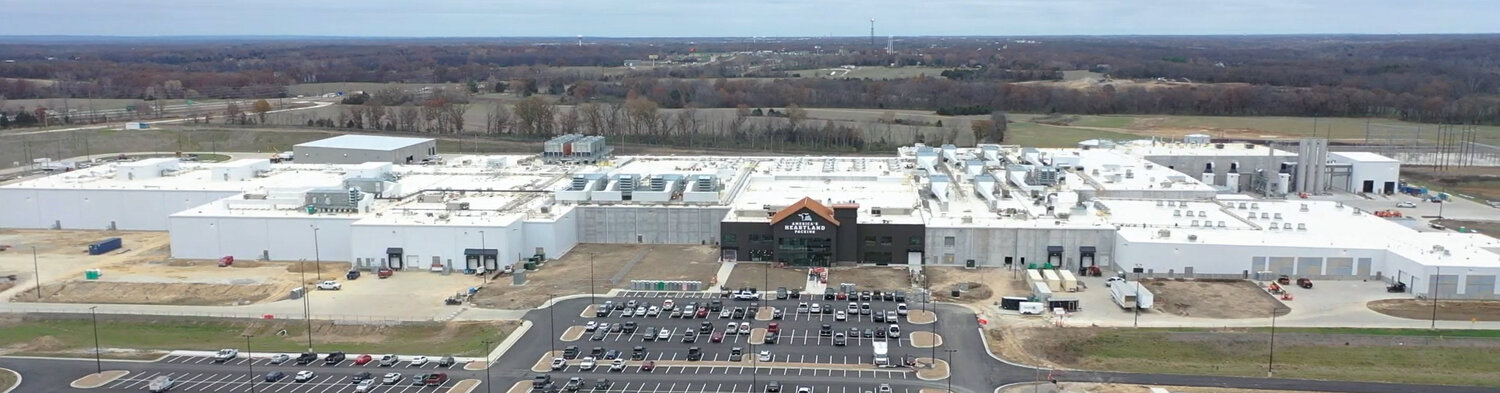
Steve Etcher with the Greater Warren County Economic Development Council to discuss the county’s existing tax abatement agreements with the two solar districts and American Foods Group on Aug. 7.
The three agreements were put together through Missouri’s Chapter 100, which is designed to spur new development and lessen the tax burden for businesses as they get off the ground.
Currently there are three active chapter 100 agreements with the county, along with several other taxing entities.
There are the two solar districts, Bluebird Solar and Split-Rail Solar, both located between Routes A and W and the America’s Heartland Packing Plant owned by American Foods Group.
Present at the meeting were Commissioners Joe Gildehaus and Matt Flake, along with Warren County Ambulance District Chief Darren Lenk, Wright City Fire Protection District Chief Ron MacKnight, Sheriff Kevin Harrison and County Assessor Katie Smith.
The group was meeting with Etcher to discuss the impact of incoming Chapter 100 payments on their tax revenue.
While the agreements do significantly decrease the tax burden for those businesses, all three are on the hook for payments in lieu of taxes, and the first of those payments should start coming in this year, according to Etcher.
Solar Districts
Etcher said both solar districts have an agreement that exempts them from the taxes associated with their new facilities. Instead, they will be making payments in lieu of taxes.
Those payments will be $2,500 per megawatt of power generated by the solar districts for the next 35 years. He said those payments will also increase by 2% each year of the agreement.
“Instead of a tax abatement, I call those a tax certainty,” said Etcher. “So they basically will make a payment based on the amount of megawatts they’re permitted to build.”
The Bluebird Solar District, being developed by DE Shaw Renewable Investments and operated by Ranger Power, sits on 1,800 acres and will generate roughly 139 megawatts of power.
The Split-Rail Solar District, being developed by Invenergy, is the larger of the two and sits on roughly 4,000 acres. It is planned to produce roughly 300 megawatts of power once completed.
The Bluebird Solar District was completed on Dec. 20, 2024 and Gildehaus said the county is expecting payments to begin on that development shortly.
“We’re going to get two checks this year, we’ll get one from December the 20th, when they went live in 2024, and then we’ll get another,” said Gildehaus. “So that’s how that works, on when they paid for 2024 that goes to 2025 so they’re actually paid ahead of time.”
The Split-Rail Solar District is scheduled for completion in the summer of 2026.
Flake also stressed that the solar districts are on the hook for any repairs the county has to make to roads related to the project. He said they have already sent an invoice for roughly $39,000 to Bluebird for repairs to Powerline Road.
Gildehaus also pointed out there are clauses in the agreements with the solar districts in case anything goes wrong.
“We have a decommissioning clause, if something goes wrong out there to where they’ve got 365 days and that 366th day, it has to be back to fertile land,” said Gildehaus.
The county has a bond on that agreement, meaning the solar districts would have to make significant payments if they missed the deadline in the case of decommissioning.
America’s Heartland Packing
Etcher also provided some clarity on what kind of revenue taxing entities can expect from the America’s Heartland Packing plant just outside of Wright City. That plant was officially completed in April and is slowly scaling up operations.
The $800 million project was a major development for Warren County, but Etcher stressed that there is a difference between the amount of money that AFG spent developing the plant, and how much is actually taxable value.
“Recognize that a number like $800 million is what a company anticipates to spend. That $800 million does not equate to $800 million of taxable assets because there’s a number of soft costs that are in there that are not taxable,” said Etcher.
AFG’s tax abatement agreement covers an 80% abatement on personal and real property taxes for the next four years and another 75% abatement on personal and real property taxes for the remaining 16 years of the agreement.
He said AFG will make payments in lieu of taxes on the remaining 20% for the next four years and then 25% for years 5-20 of the agreement.
Etcher said they are projecting roughly $650 million of taxable value from that project, including roughly $222 million in real property and $450 million in personal property.
According to Smith, the real property improvements were only assessed at $170 million in 2025, since they were not in operation during the first four months of the year. That value is expected to increase to roughly $200 million in 2026.
Etcher also noted the personal property is on a depreciation schedule, with $1 million depreciating over five years, an additional $359 million over seven years, and the remaining $68 million over 15 years.
Etcher also addressed concerns with the Hancock Amendment. The Hancock Amendment is legislation in Missouri designed to reign in tax increases.
If a taxing entity’s tax revenue increases by more than 5% or the Consumer Price Index rate of inflation in a given year, whichever is lower, the entity must lower their tax rate to match the increase.
Etcher said since the real property improvements are considered new construction, they are exempt from the Hancock Amendment. Furthermore, he said the first $170 million would be considered new construction in 2025, with the remaining $30 million as new construction in 2026.
He said this was to lessen the impact of the new revenue on taxing entities.