They say a picture is worth a thousand words. More than one thousand years ago, Native Americans in Warren County used pictures to tell their war stories, dreams, traditions, and beliefs.
On …
This item is available in full to subscribers.
We have recently launched a new and improved website. To continue reading, you will need to either log into your subscriber account, or purchase a new subscription.
If you are a digital subscriber with an active subscription, or you are a print subscriber who had access to our previous wesbite, then you already have an account here. Just reset your password if you have not yet logged in to your account on this new site.
If you are a current print subscriber and did not have a user account on our previous website, you can set up a free website account by clicking here.
Otherwise, click here to view your options for subscribing.
Please log in to continue |

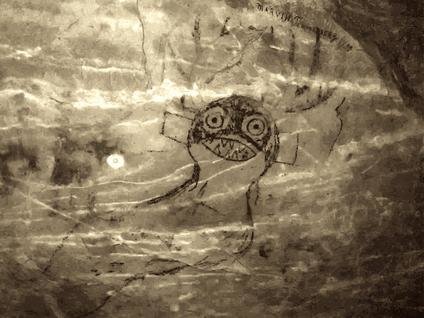


They say a picture is worth a thousand words. More than one thousand years ago, Native Americans in Warren County used pictures to tell their war stories, dreams, traditions, and beliefs.
On October 27 in the Warrenton High School auditorium, archaeologist and professor emeritus Michael Fuller took a crowd of more than 100 people on a virtual tour of Warren County’s “Picture Cave,” the site of the single largest number of prehistoric images in Missouri and an important historic site in the United States.
The 294 polychrome paintings by the indigenous people of Warren County were completed around A.D. 900 with materials like iron, silicon, manganese, and aluminum.
“We owe a debt of gratitude to the Native American artists who painted the wondrous scenes on the walls of caves and shelters in Warren County,” Fuller said.
The drawings in Picture Cave are not just individual images but scenes depicted across sprawling sections of the cave’s walls, reading from right to left. The panels tell stories of great and powerful leaders and warriors, times of prosperity, and bloody battles. They contain red, black, and white pigments.
“There is a painting of a sandhill crane and even a painting that I believe may represent the Milky Way,” Fuller said.
Fuller explored the cave in November 2020 to further investigate the discovery of the indigenous paintings. He completed chemical analysis and used image enhancement technology to reveal additional details in the drawings.
“We were using something called a handheld X-ray fluorescent analyzer,” said Fuller. “It is a non-destructive method of determining chemical content of things like pigments.”
In this exploration, Fuller was accompanied by citizen archaeologists and an elder from the Osage Nation.
Interesting facts about Warren County’s Picture Cave:
• Archaeologists believe the cave itself was initially discovered around A.D. 900 by Native Americans. (However, there have been artifacts discovered in Warren County that date back to 9000 B.C.).
• Specialized carbon dating puts the first drawings in the cave between A.D. 860 and 950.
• European Americans rediscovered the cave in the early 1800s; one theory is that a bear hunter stumbled upon it in pursuit of his prey.
• Fuller has a theory that the blood of either humans or animals was used to compose some of the paintings.
• There are two separate chambers in the cave that may have been joined at one time.
• Only three known sites in Missouri have drawings using white pigment — Picture Cave is one.
• The artists may have come by some of their painting materials by trading with tribes from hundreds of miles away. Warren County was at the edge of “Greater Cahokia,” an area whose trade, political, and economic reach extended from the Gulf of Mexico to Minnesota.
The drawings depict the common elements of life for Native Americans in A.D. 900, communicated in the way that people understood at the time. The original artists would, for example, put antlers on animals that typically did not have them, such as snakes, to represent masculinity and great power.
In the days of vanishing social media posts and extensive filters and frames that make one question reality, the purity and rawness of Picture Cave’s nearly 300 drawings hold an appeal as something that connects the modern world to its ancient history.
The cave containing the paintings was sold in September 2021 to private owners for $2.2 million. Fuller has no idea who the new owners are, though he has received what he calls “red herrings” ranging from a European nobleman to a famous Hollywood actor.
The cave is not open or explorable to the public, nor are there any public plans to make it so. Anyone who wants to explore and attempt to interpret the cave drawings for themselves will need to pick up a copy of Fuller’s forthcoming book, “Painted Caves of Missouri.”
Scenic Regional Library organized Fuller’s Picture Cave lecture. Other upcoming library events include “Notorious Missouri: 200 Years of Historic Crimes” on November 30 and a virtual live presentation from Hawaii by the “Pearl Harbor Child” on December 7.